

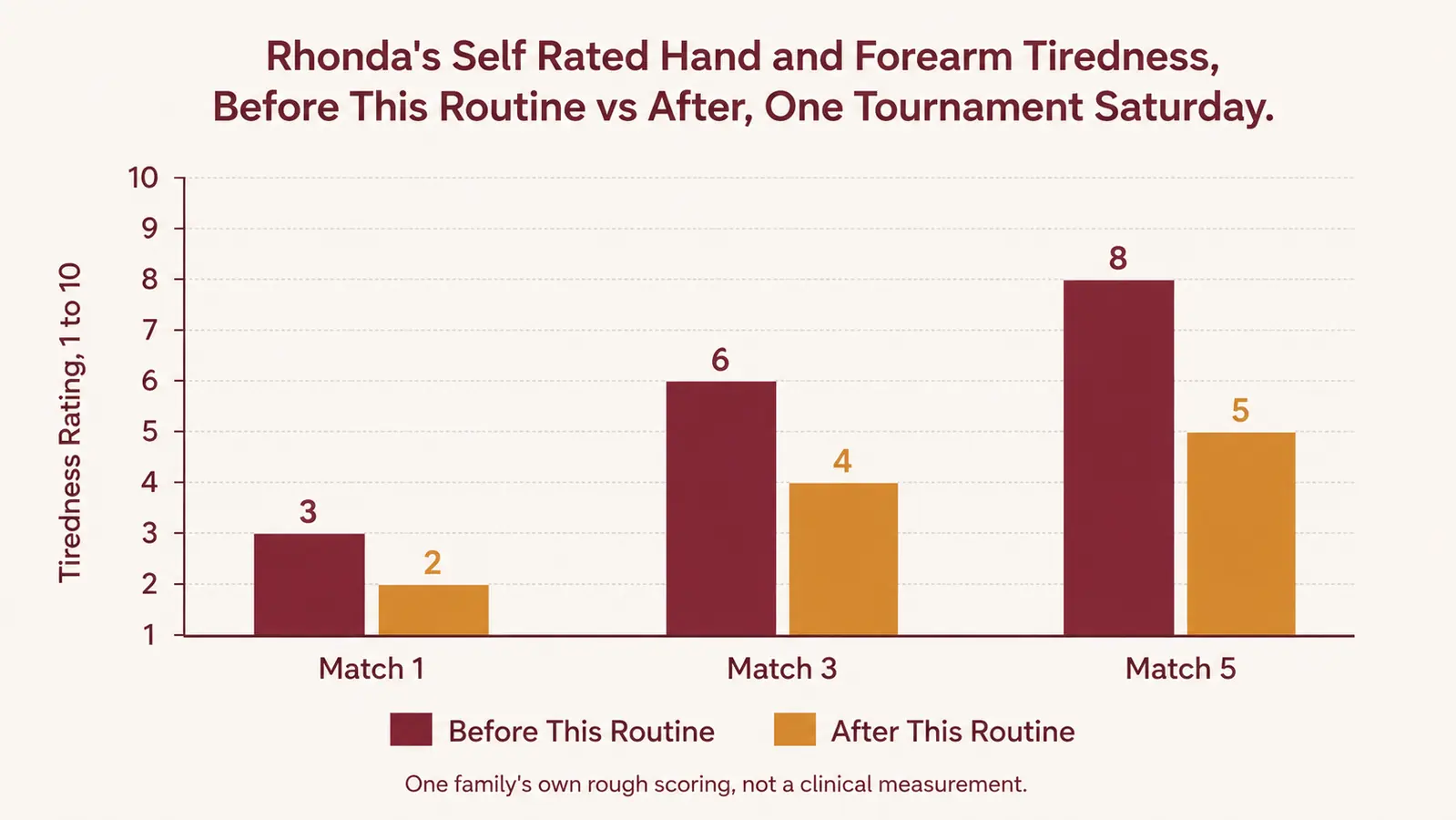
By the third match of a Saturday tournament, my hands are the first thing to go. Not my back, not my feet, my hands. Eleven years of hauling the cooler out of the back of the Pilot, folding and unfolding the same metal camp chairs, gripping straps that never loosen no matter how many times I carry them, and by the fourth match my grip feels like it belongs to someone twenty years older than I actually am. I used to think that was just what fifty four felt like, and some of it probably is. But over the last year I put together an actual routine for it, most of it free, and the one piece of gear that ended up sticking around at the bottom of the bag is the INDEEMAX Copper Wrist Compression Sleeve.
I want to be upfront before I get into any of it. I am not a trainer or a physical therapist, I am a transportation scheduler who spends her Saturdays on rec center bleachers, and everything below is what actually worked for my own hands and forearms after years of trial and error. It is not a treatment plan for anything more serious than the ordinary ache of a long day spent lifting and gripping. If what you are dealing with is more than that, the last step below covers exactly where I draw that line.
Your Hands Do the Same Work as Your Back on a Tournament Day
Coolers, chairs, tailgates, snack bins. Nobody plans a routine around tired hands until they are the ones aching by match four. See today's price on the sleeve I actually keep at the bottom of the bag.
Amazon Check Today's Price on Amazon →Step 1: Warm Up Your Hands Before You Ever Touch the Cooler
On tournament mornings my hands are already a little stiff before I load anything, since we usually leave the house around six thirty and the garage is cool. I stand at the open hatch and do a slow set of wrist circles, ten each direction, then spread my fingers as wide as they will go and hold for a few seconds, three or four times through. It costs nothing and it takes maybe ninety seconds, but skipping it means the first cooler lift of the day sets the tone for how my hands feel by match three.
I also press my palms together in front of my chest like a prayer stretch and gently push down until I feel it along the underside of my forearms, holding for twenty seconds or so. Mari's club trainer showed her a version of this for her hands after sets, and I borrowed it for myself. It is not complicated and it will not fix an actual problem, but for the ordinary stiffness of a fifty four year old climbing into a loaded car, it genuinely helps.
Theo does a rougher version of this before weigh ins, mostly because his forearms take a beating from gripping during matches, not from hauling anything. I taught him the same wrist circles and finger spreads I do myself, and he actually does them now without me nagging, which after fourteen years of parenting a teenager I consider a genuine win. It costs nothing, it takes less than two minutes, and it is the easiest step on this whole list to actually stick with.
Step 2: Change How You Actually Carry the Load
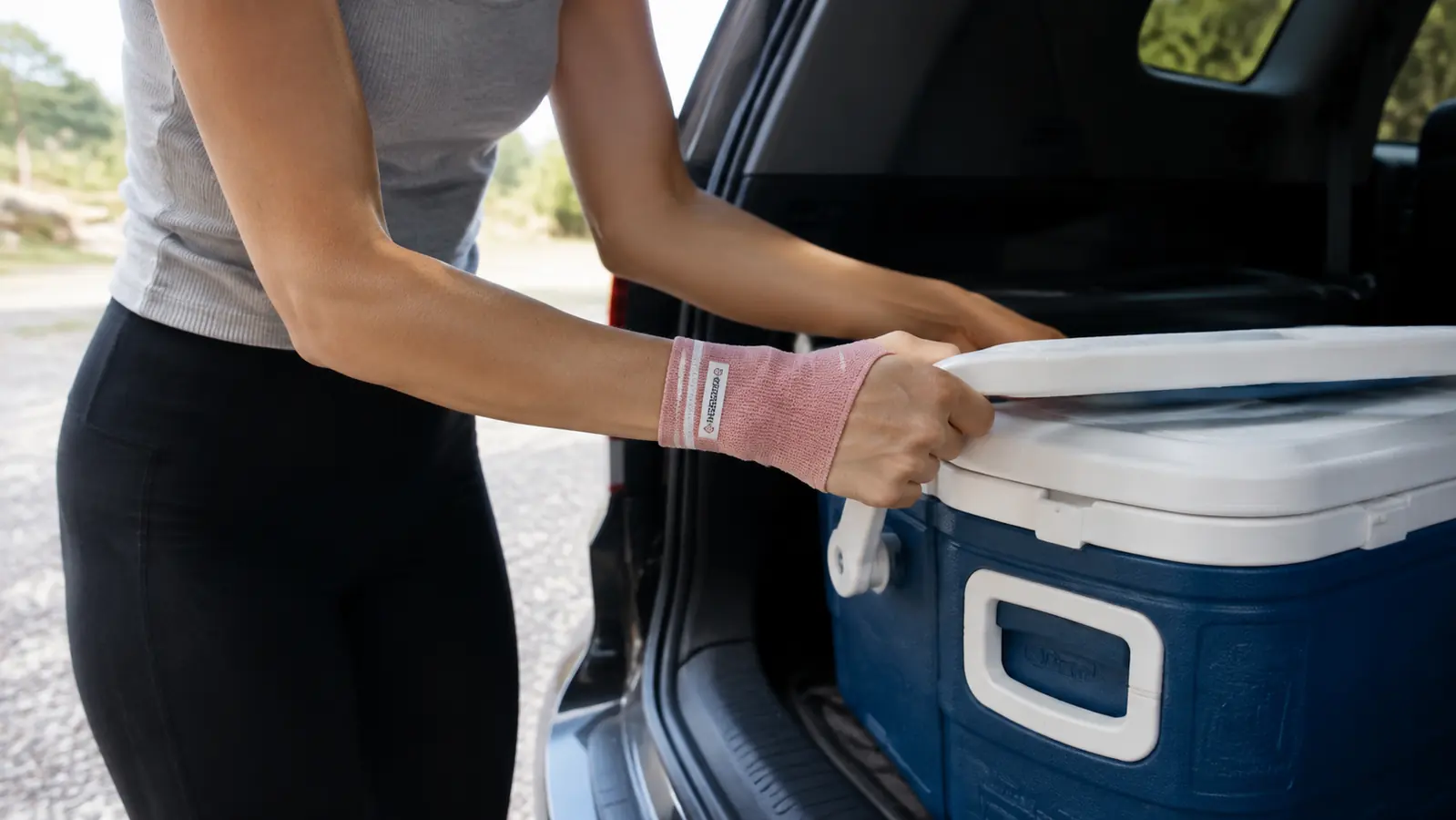
For years I hauled the big cooler with one hand and a stack of folding chairs hooked over the other arm, because it meant fewer trips between the Pilot and the gym door. That habit is probably half the reason my hands felt the way they did by early afternoon. Now I make myself take two trips instead of one when the cooler is full, carrying it with both hands in front of me instead of letting the handle dig into one set of fingers the whole way across the lot.
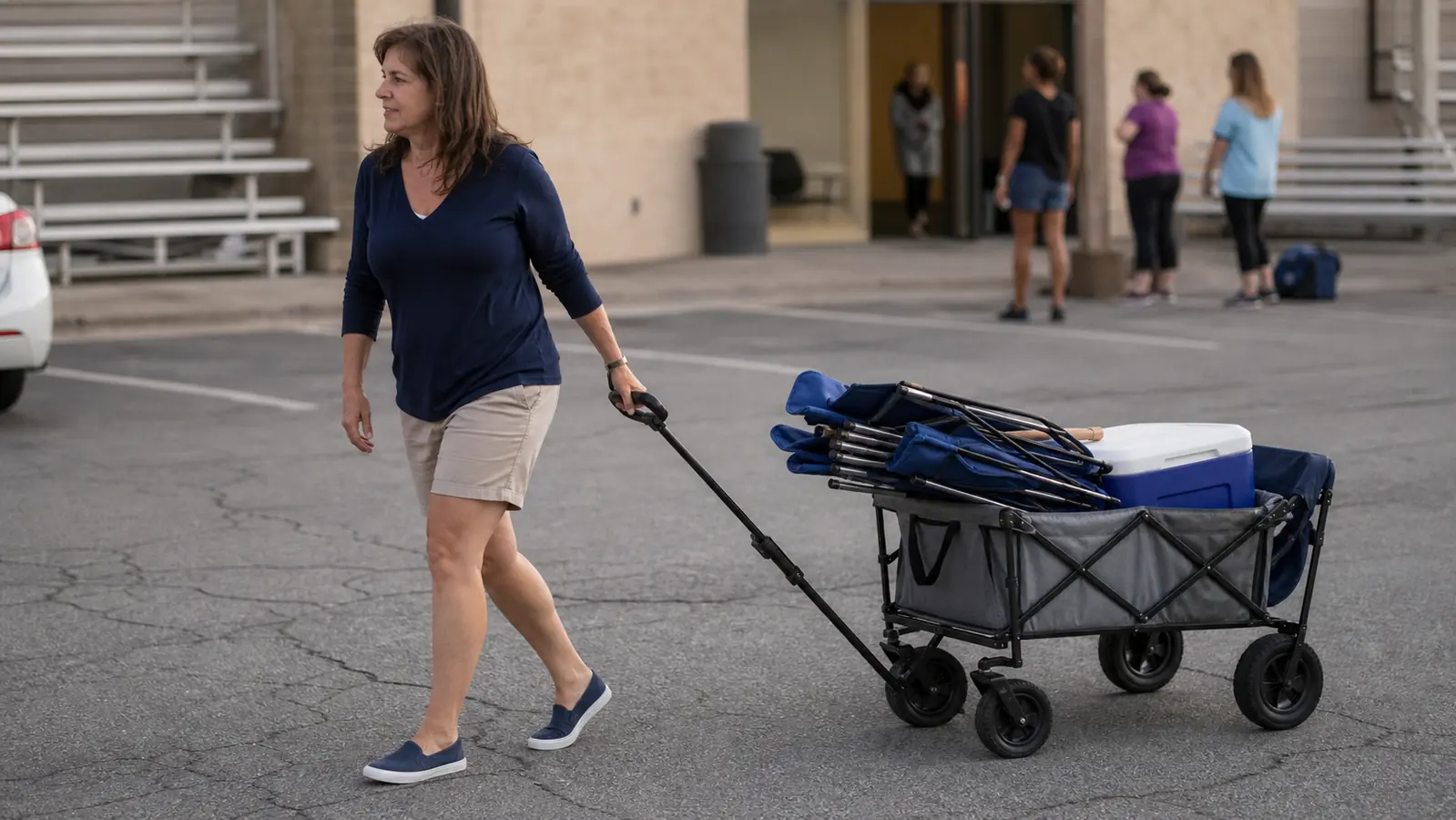
We also finally started using a folding utility wagon for the chairs and snack bins, so my hands are pushing instead of gripping and hauling for that leg of the trip. It sounds like a small thing, and it cost us nothing since it was already sitting in the garage from a camping trip two summers ago. Switching which hand does the heavier carrying from match to match, instead of always defaulting to my dominant side, has made a real difference too.
The wagon is not perfect. One wheel sticks a little on gravel, and Mari has learned to give it an extra shove when we cross the rougher patches of the rec center lot. But even a slightly stubborn wagon wheel is easier on my hands than another cooler handle, and that is really the whole point of this step. It is not about finding a perfect solution, it is about moving the work off my fingers and onto something with wheels wherever I actually can.
Step 3: Give Your Grip Small Breaks Between Matches
Between matches, while I am sitting on the bleachers watching Mari set or half listening for Theo's weigh in results, I open and close my hands slowly, full spread to full fist, about twenty times through. Some Saturdays I bring a cheap stress ball I keep in the glove box, squeezing and releasing instead of just sitting there letting my hands do nothing useful.
I also use the drive between the house and the gym for this, since red lights are a built in excuse to do a round of it without looking like I am doing anything unusual. Danny thinks it is a little odd, but he also is not the one whose hands are cramping by the fourth match, so I have stopped explaining myself.
It does not look like much from the outside, and I have gotten a few funny looks from other parents on the bleachers, but by the fourth match my grip feels noticeably less locked up on the days I actually do this compared to the days I forget. This step and step one cost nothing, which is worth saying, because not every piece of a routine like this needs to involve buying something new.
Step 4: Wear Compression on the Drive Home and During Cleanup
This is where the INDEEMAX Copper Wrist Compression Sleeve actually earns its spot in my bag. I do not put it on first thing in the morning. I put it on for the second half of the day, usually starting around match three, and I keep it on through loading the car back up and the drive home. That is when my hands are at their worst, and steady, even pressure around the wrist seems to help me notice the ache less while I still have to be functional behind the wheel.
I want to be straightforward about what I think is actually happening here, because the packaging leans hard on the word copper and I do not think that is the real story. The compression itself, the steady pressure wrapped around the wrist and lower palm, is the part with any real support behind it, and even that effect is modest, not a cure for anything. I have not seen anything that convinces me the copper woven into the fabric is doing something the plain compression is not already doing on its own. I wear the INDEEMAX sleeve because the compression helps me get through the drive home with less complaining, not because I believe in the copper. If you are weighing this against a pair of copper gloves, I put both side by side in my wrist compression versus copper gloves comparison, and the honest answer is closer than the marketing on either one suggests.
Danny tried the INDEEMAX sleeve exactly once, on his good hand, and shrugged it off, since his real problem is his shoulder and this does nothing for that kind of ache. For my hands, and for Theo's forearms after a hard wrestling match, it has become a normal part of the bag, something I hand over the same way I hand over a water bottle. I go into a lot more of what I like and do not like about it, including where the listing oversells it, in my honest review of the INDEEMAX sleeve, and I would read that before you order one.
One honest note on upkeep. The INDEEMAX sleeve goes through the wash more often than I expected, since a full day in a gym bag next to sunscreen and snack wrappers does not leave it smelling great. It has held up fine through regular washing so far, no fraying, no loosened stitching, but I would not call it a set it and forget it piece of gear. It is one more small thing to remember to toss in with the towels on Sunday, same as everything else in this routine.
Step 5: Know the Difference Between Tired and Something Else
Everything above is for ordinary tired. Sore, stiff, worn out from a six hour day of gripping and hauling, the kind of tired that a good night's sleep and a lighter Sunday mostly fix. I am not a doctor, I am not a physical therapist, and I want to be very clear that nothing in this routine, including the sleeve, is meant to treat an actual injury.
If your hand goes numb, if you notice real weakness, like you cannot hold onto something you normally could, if the pain keeps getting worse from one weekend to the next instead of easing off, or if it wakes you up at night, that is not a compression sleeve question anymore. That is a doctor's question. Danny will not make his own appointments, so I have learned to just make them for him when something crosses that line, and I would tell you to do the same for yourself rather than talk yourself out of it because a sleeve made things feel better for a while.
Short of that line, plain rest still does more than any single step above. On the worst Saturdays I will skip the wagon, skip the stretches, and just tell Mari I need ten minutes with my hands doing absolutely nothing before I touch another chair. There is no gear or routine that replaces just stopping for a bit when your body is asking for it, and I have gotten better over the years at actually listening to that instead of pushing through out of habit.
What Else Helps
Outside of tournament days, a warm soak with epsom salt on a Sunday night does more for my hands than almost anything else in this routine, and it is close to free once you have bought the bag of salt once. Danny's shoulder responds to heat, not the cold or compression that works for my hands, so we keep a heating pad in rotation for him separately, and I have learned not to expect one routine to cover a whole family. None of this replaces the actual guidance Mari gets from her club trainer, who is the person I defer to any time one of the kids' aches starts sounding like more than ordinary soreness. If you want the fuller list of reasons this kind of gear earns a permanent spot in our bag, I laid out ten of them in a separate piece worth a look.
The sleeve did not fix anything. It just made the drive home a little less miserable, and most days that is exactly what I need it to do.
Still the Last Thing I Reach For Before the Drive Home
It will not undo eleven years of hauling coolers, and I do not think the copper is doing much of anything. The plain compression is what actually helps my hands get through the rest of a tournament Saturday. See today's price and decide if it earns a spot in your own bag.
Amazon Check Today's Price on Amazon →