

If you spend any time around teenage athletes in gyms and wrestling rooms out here in Grand Junction, sooner or later a parent brings up amino acid powders. Mari's club volleyball teammates trade opinions on flavored BCAA tubs the same way I used to trade opinions on orthodontists at the snack table. Last winter one of Theo's wrestling teammates showed up to an early Saturday weigh in with a plain, unlabeled looking white jar tucked next to his water bottle. It turned out to be Nutricost L-Glutamine powder, and it started a conversation in our house that took me longer to sort through than I expected.
Here is the short answer before the table, because I do not want to bury it under two thousand words of side by side comparing. Neither one of these powders is impressive for a healthy kid who is already eating real meals. Both L-glutamine, like that plain jar of Nutricost powder, and BCAA powders are amino acids, the same building blocks Mari and Theo already get from chicken, eggs, milk, and the protein bars I keep in the Pilot's glove box. If they are eating enough protein most days, and most club and wrestling kids I know are, a scoop of either one is mostly a habit, not a mechanism. I am not a nutritionist, a trainer, or a doctor, and before either of my kids started using anything from a tub regularly, I ran it past the actual trainer at Mari's club and, for Theo, his pediatrician. Any family with a minor athlete should do the same before this decision gets made on a parent's gut feeling alone, mine included.
| Nutricost L-Glutamine | Flavored BCAA Powder | |
|---|---|---|
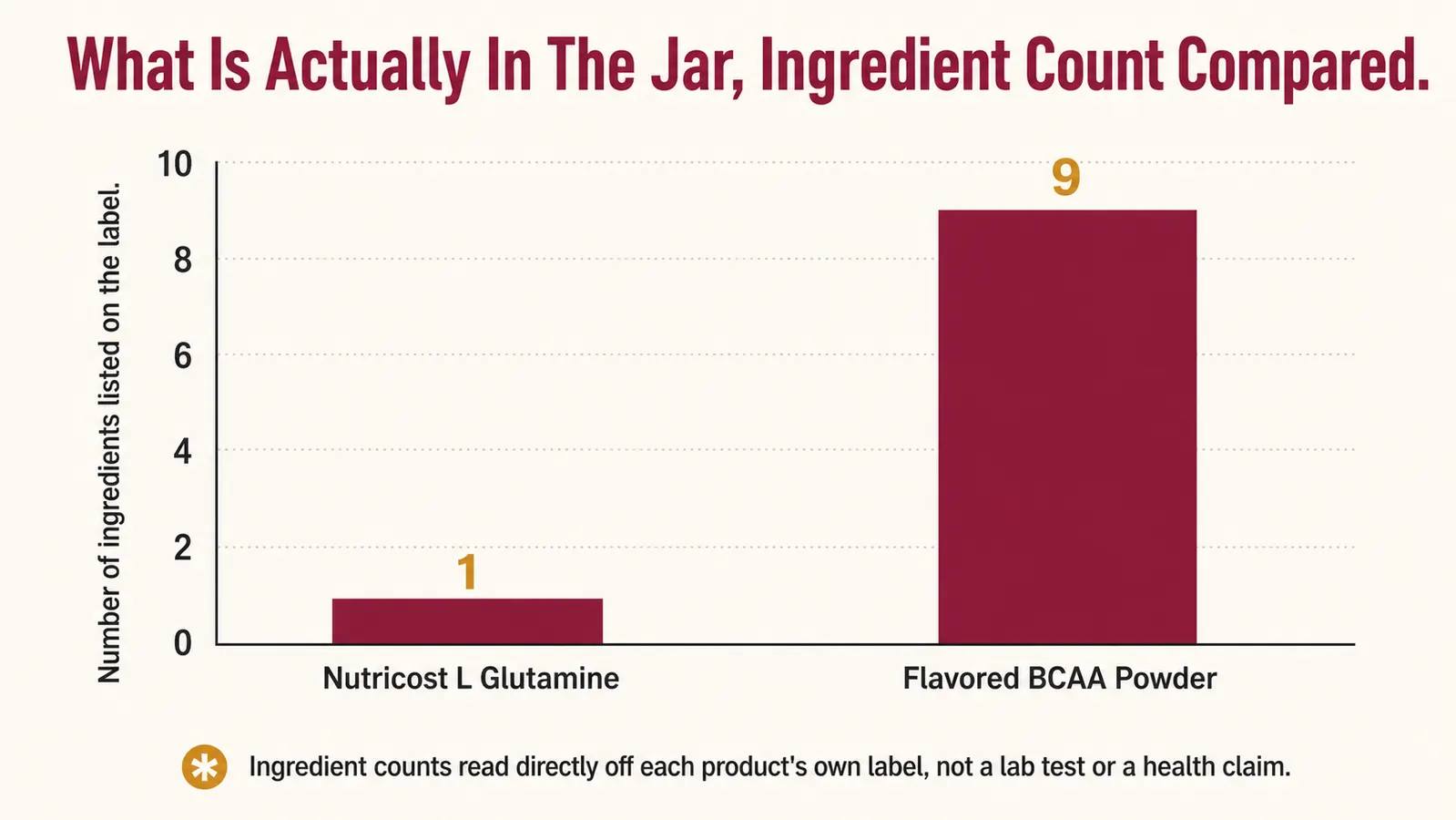
| Main Ingredient | Single ingredient, powdered L-glutamine and nothing else in the jar | A blend of three branched chain aminos (leucine, isoleucine, valine) plus flavoring and a sweetener system |
| Taste On Its Own | Flavorless, chalky and a little bitter if you try to drink it straight in plain water | Comes in fruit flavors most kids will drink straight out of a shaker bottle without complaint |
| Mixing Into What They Already Drink | Dissolves into a smoothie, juice, or milk without changing the taste much | Pretty much has to be its own drink, since the flavoring clashes with almost anything it is added to |
| What The Label Leans On | Marketing often points at gut and immune support research done mostly in surgical and ICU patients, not two teenagers already eating dinner | Marketing often points at muscle recovery and soreness research done mostly on trained adults running multiple hard sessions a day |
| Cost Per Serving | Runs less per scoop since it is one raw ingredient with no flavor system to pay for | Runs more per scoop, since part of the cost is the blending, flavoring, and sweetening |
| Necessary If Meals Are Already Solid | Mostly redundant on a night when dinner already covered enough protein, the extra amount is largely used as fuel or passed through | Also mostly redundant on the same kind of night, since food already supplies the same amino acids |
| Fits Into An Actual Weeknight Habit | One scoop, one ingredient, easy to keep track of without overthinking it before or after practice | Requires tracking flavor preference, timing around practice, and whether it clashes with whatever else is in the water bottle |
Where Nutricost L-Glutamine Wins
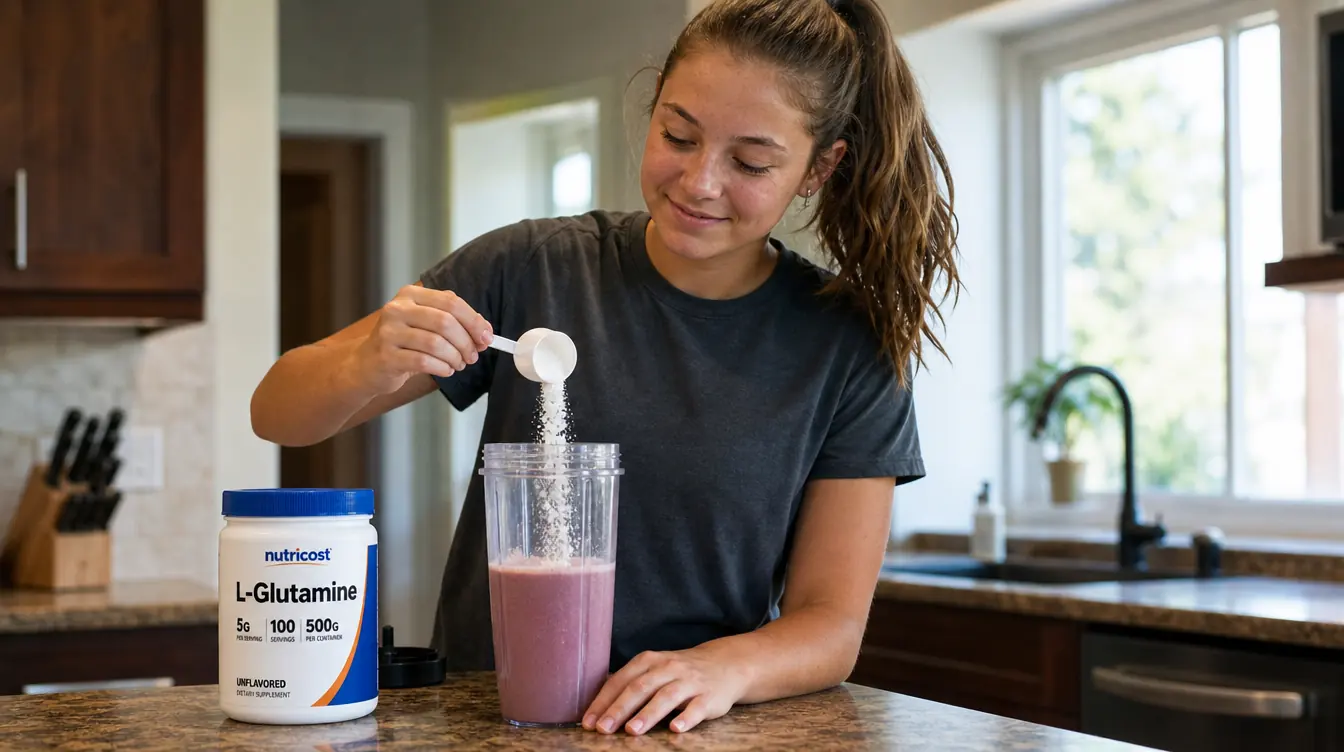
The plain jar wins on simplicity, not on outcomes. Nutricost L-Glutamine powder is one ingredient, powdered L-glutamine and nothing else, which means I can drop a scoop into whatever Mari or Theo is already drinking, a post practice smoothie, orange juice, even a glass of milk, without changing the taste much. That matters more than it should in a house where getting a fourteen year old to take anything consistently is its own small project. The flavored BCAA tubs the other volleyball parents pass around are basically their own drink. You mix BCAA powder with water and that is the whole plan, because the fruit punch or blue raspberry flavoring fights with almost anything else you would add it to.
It also runs cheaper per scoop, since you are paying for one raw ingredient instead of a blend, a flavor system, and a sweetener. And because the jar is unflavored, there is no argument in this house about which flavor to buy next, no half empty tub of a flavor nobody liked sitting in the back of the pantry behind the protein bars. Nutricost is the version of this I would actually keep restocking, not because it does more, but because it asks less of me on a Tuesday night when I am also packing lunches and hunting down Theo's headgear.
There is also a storage argument for the plain jar that surprised me once I noticed it. One canister of unflavored powder takes up less pantry space than the two or three flavors of BCAA some of Mari's teammates rotate through, and because nobody is deciding between flavors, there is no half used tub of something nobody liked pushed to the back of the shelf behind the protein bars. It has also held up fine through a full season riding in a hot Pilot on August tournament weekends, no clumping, no hardened scoop stuck at the bottom the way I have seen happen to a flavored tub left in a hot car.
Where BCAA Powder Wins
The flavored BCAA tubs earn their keep on one honest thing, teenagers will actually drink them straight. Theo's wrestling teammate shakes his up in a bottle and drinks it on its own, no smoothie or juice required to make it go down easy. Nutricost L-Glutamine, being flavorless, is close to unpleasant on its own in plain water, which means it really does need to be mixed into something else. If your kid will not touch a smoothie and wants a drink that actually tastes like something, the BCAA tub wins that argument outright, and a supplement nobody drinks helps nobody.
BCAA marketing also leans harder on muscle recovery and soreness language, built around research done on adult lifters running multiple hard training sessions a day, not a seventeen year old setter playing three matches on a Saturday. I want to be honest about that instead of pretending the fancier label means more is happening in Mari's body. It probably does not, as far as the research on kids in her situation actually goes. But if what you are after is a drink that tastes good enough that a teenager keeps drinking it without being nagged, that is a real, if modest, win for the BCAA side.
There is a social piece to this too, and I would be leaving something out if I skipped it. Half of Mari's teammates already carry some flavor of BCAA powder in their bags, trade flavors before matches, and treat it a little like a team ritual. A plain white jar of Nutricost does not fit that same social moment, nobody is passing it around and comparing flavors on the bench. If that peer piece is part of what actually gets your kid fueling consistently, do not discount it just because the ingredient list on the flavored tub is longer.
What the Evidence Actually Supports, and What It Does Not
I read through what I could find on both of these before I let either kid keep using them, and the honest picture is underwhelming for our situation either way. Most of the research showing a real benefit from L-glutamine involves people who are seriously ill, recovering from major surgery, or dealing with burns, situations where the body's own glutamine production cannot keep up with demand. That is not Mari after a volleyball tournament or Theo after a wrestling match. The BCAA research that gets quoted in supplement marketing mostly comes from studies on trained adults, often ones already under eating protein relative to their training load, which describes almost nobody in a house where I am cooking dinner every night.
I want to be direct about something else too. I am not going to tell you either one speeds up recovery, prevents soreness the next morning, reduces muscle breakdown, or supports the immune system for a normal healthy teenager, because the evidence I could find does not support that claim for kids in Mari and Theo's situation, and I am not qualified to stretch it into one. What both of them mostly do in our house is give a kid a routine around fueling, which has its own quiet value, even when the ingredient itself is not doing anything dramatic. If your family is dealing with a documented deficiency, a medical condition, or a training load nothing like a typical high school season, that is a different conversation entirely, and it belongs with a doctor, not a supplement label.
I also looked at how much of each amino acid actually shows up in a single scoop against what a typical teenage athlete already gets from food in a day, and the amounts were smaller than either label's marketing tone suggested. One scoop of glutamine or BCAA powder is a fraction of what a normal serving of chicken, eggs, or a glass of milk already provides. That is not a knock on either product specifically, it is more of a sizing problem. A single scoop was never going to move much sitting next to a full dinner plate.
If I am being fully honest, the food conversation matters more than either jar. Most nights the bigger lever in this house is whether Mari and Theo actually ate enough protein at dinner, not what got stirred into a shaker bottle afterward. Most families probably need neither of these, and if you already feed your athlete regular meals with real protein at them, you can likely skip this aisle entirely. I wrote up a full season of using Nutricost L-Glutamine powder with both kids, servings, timing, and what actually changed and what did not, in my long term Nutricost L-Glutamine review, if you want the fuller picture before deciding either powder is worth the cabinet space.
Deciding between a plain jar and a flavored tub? Here is the honest case for keeping it simple.
Nutricost L-Glutamine is one ingredient, mixes into whatever your athlete is already drinking, and runs less per scoop than a flavored blend. It is not a miracle and I will not tell you it is, but if you have already decided to buy one of these, this is the version I would actually keep restocking. See today's price and current availability on Amazon.
Amazon Check Today's Price on Amazon →
Who Should Buy Which
If your kid is like Theo's teammate and will not touch anything that is not flavored, a BCAA tub might be the only version that actually gets used, and a supplement that sits unused in the cabinet helps nobody regardless of what the label promises. If your kid already drinks a smoothie or a glass of milk after practice and you just want one plain ingredient you can stir into it without an argument, that is exactly the case where Nutricost L-Glutamine earns its spot instead. Either way, talk to your athlete's trainer or their pediatrician before making it a regular habit, especially for a minor, the same way I did before I let either of my kids keep using anything from a tub. For the actual mechanics of working a scoop of Nutricost into a teenager's routine without turning it into a nightly negotiation, I put together how we added glutamine powder to a teen athlete's routine.
I will say this plainly one more time because it matters more than the whole comparison above. These are supplements for minors, and that is a different category than a decision I would ever make on my own judgment standing in a store aisle. Mari and Theo do not get to add anything new to their routine without me checking it against her club trainer or their pediatrician first, and I would tell any other parent in this situation the same thing, regardless of which jar they are leaning toward.
Already decided a plain, single ingredient powder makes more sense than a flavored blend?
Nutricost L-Glutamine is what I would actually restock for this house, unflavored, one ingredient, and easy to mix into whatever the kids are already drinking. Check today's price on Amazon before your next tournament weekend.
Amazon Check Today's Price on Amazon →