
Mari's first serve of a match used to look nothing like her third. Her shoulder needed a set or two to loosen up, and for years that meant she just served worse for the first few points while her body caught up. Theo has the opposite problem twice over, wrestling season means his first match of a Saturday can come after an hour of sitting around a gym waiting for weigh ins and bracket seeding, hips and shoulders gone cold and stiff before he ever steps on the mat. Neither of my kids has a coach standing over them doing this for them before every single match, so the actual trainer at Mari's club and Theo's wrestling coach have both, separately, landed on some version of the same answer, a resistance band with handles that a teenager can run through by themselves in a corner of the gym in a few minutes, no equipment room, no coach required. Ours is the VEICK band with handles that lives in the bottom of the tournament bag now, next to the ice packs and water bottles.
I want to say plainly that I did not come up with any of this. I'm a sports parent who has watched Mari's trainer run this same band routine before warm ups more Saturdays than I can count, and watched Theo's wrestling coach have the boys go through something similar before early matches. What follows is what I've actually seen them do, not something I'm prescribing myself, and if any of it causes real pain rather than the ordinary tightness of sitting on a bus or a bleacher, that is a conversation for the actual trainer or a doctor, not for me. This is one family's version of a routine that repeats most Saturdays, not a program, and I'd rather say that up front than let it sound more official than it is.
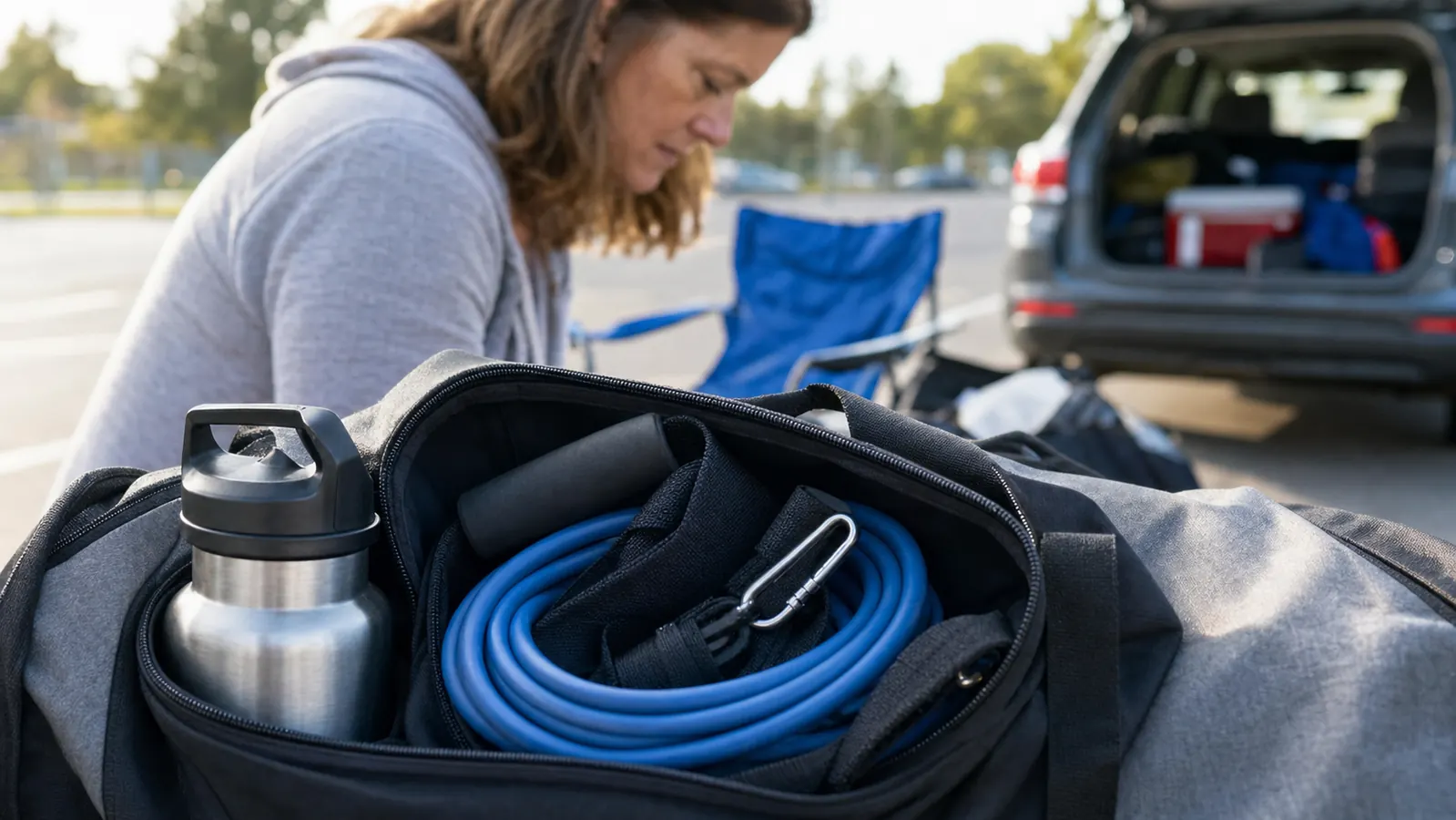
Part of why this particular routine stuck is the equipment itself. The VEICK set folds down small enough to fit in a side pocket of the tournament bag next to the water bottles, and it comes with a handful of bands of different resistance stacked together, handles, ankle straps, and a door anchor, though we have never once needed the door anchor for any of this. Everything below happens in five minutes or less, standing in a gym corner or a hallway, and none of it requires a wall, a rack, or another person holding anything steady.
Waiting Until the Whistle Blows to Warm Up? That's Backwards.
The VEICK band with handles is the one thing Mari and Theo actually remember to grab before matches, because it packs flat, needs no wall or rack, and works in a hallway or a gym corner in a few minutes. See today's price and current availability on Amazon.
Amazon Check Today's Price on Amazon →Step 1: Pull the Shoulders Awake First
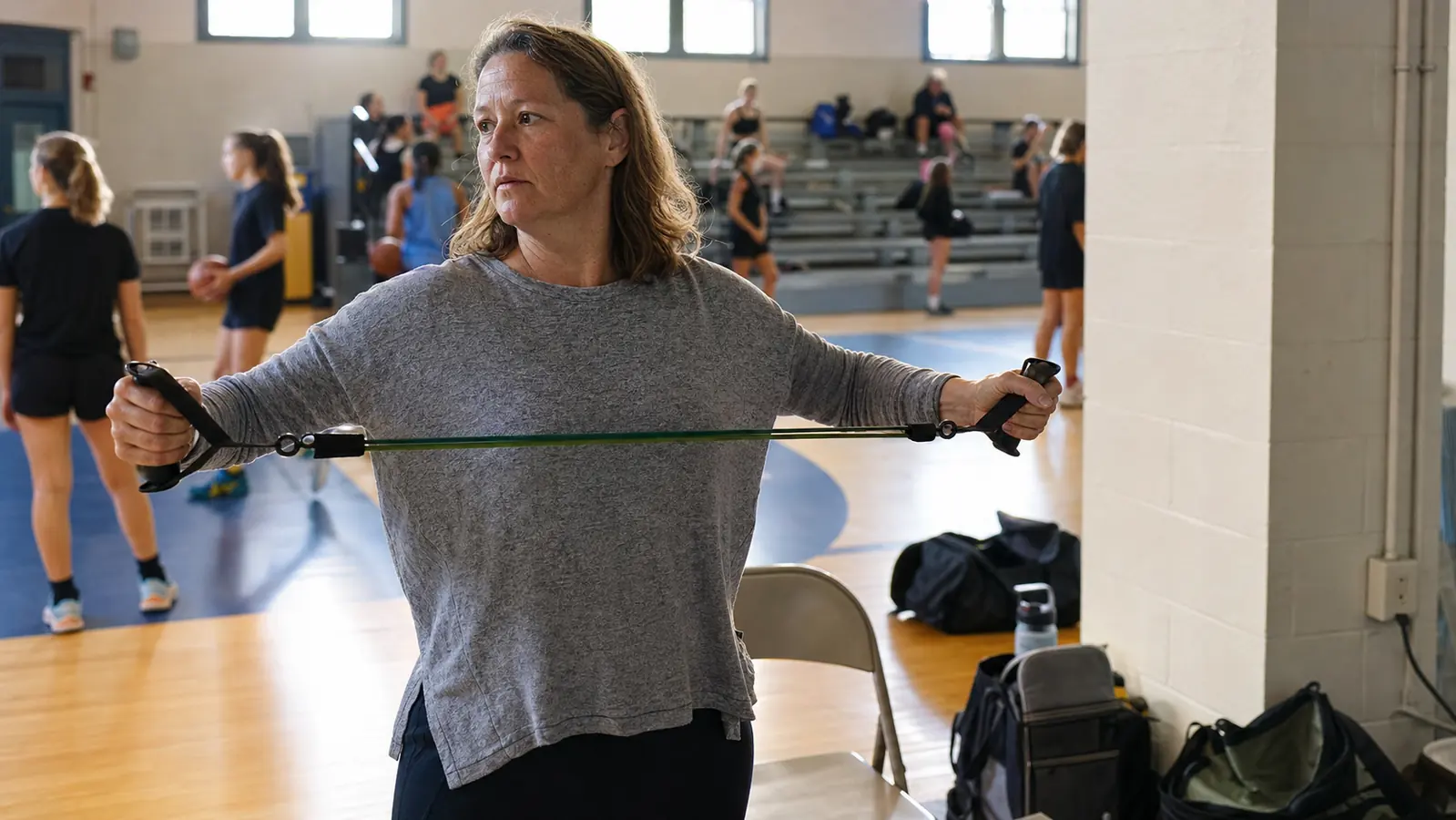
Mari's trainer starts the whole team the same way, standing in a loose line along the sideline, a handle in each hand, arms out in front at chest height. They pull the band apart across the chest and let it come back slow, over and over, for about a minute before anyone touches a ball. It is not a stretch and nobody is trying to feel a pull anywhere. The point, as the trainer explained it to a group of parents last season, is just getting blood moving through the shoulder before it has to do anything fast.
The VEICK band works well for this because the handles give a teenager something solid to grip without a coach standing there adjusting their hands, and the tension is light enough that even Theo, who is stronger than most boys at his weight class, does not reach for the heaviest of the five bands in the set. Fifteen to twenty slow pulls is what I usually see Mari do before she picks up a volleyball at all, and she does it without being told anymore.
Theo's wrestling coach has the boys do something close to it before early matches, standing near the bracket board where they are already waiting around anyway. It takes less than a minute and does not require finding a wall, a rack, or anyone's help, which matters on a morning when half the gym is roped off for weigh ins and there is nowhere obvious to stretch.
Step 2: Raise the Arms Overhead
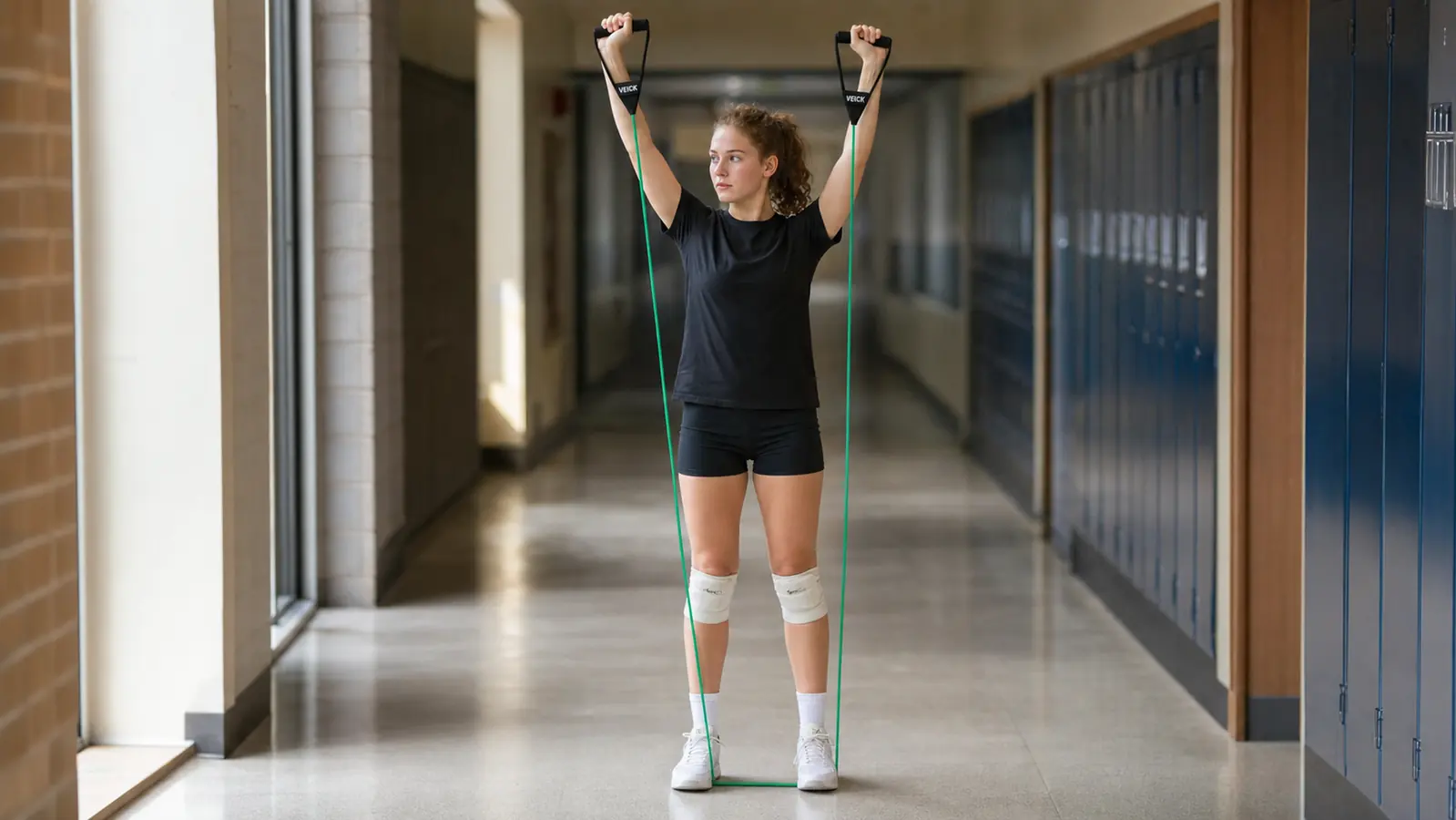
After the pull aparts, Mari's trainer has the team step on the middle of the band with both feet, take a handle in each hand, and raise both arms straight overhead a dozen or so times. It is meant to warm up the same overhead motion a volleyball serve or a spike uses, since a cold shoulder reaching all the way overhead for the first time in a match is exactly when Mari says hers used to bother her.
This is where having a band with real handles, rather than a plain loop, makes a difference for a teenager warming up alone. Mari can step on the VEICK band, get both handles set, and go through the motion without anyone holding the other end steady for her, which matters if she is warming up in a gym corner before a coach has even shown up for the day.
I've watched her do this in a hallway outside the locker room more Saturdays than I can count now, band under her sneakers, working through it while she waits for the rest of the team to trickle in off the bus or out of the parking lot. It has become as automatic as tying her shoes.
Step 3: Hinge at the Hips
For the hips, the movement I see most is a simple hinge. Feet on the band, handles held down at the hips, a slow bend forward from the hips with a flat back, then back up. It looks almost too simple to matter, but Theo's wrestling coach has the team run through a version of it before early morning matches, when the boys have been sitting on folding chairs for an hour waiting on weigh ins and bracket seeding, hips gone stiff and cold before anyone has stepped on a mat.
A dozen slow hinges is usually enough. Nobody is chasing a deep stretch here, the goal is just getting the hips moving through the same motion they will need in a stance a few minutes later. I have seen Theo skip this on rushed mornings and I can tell the difference in how he moves through the first period, slower off the whistle and a little more stiff getting back up off the mat.
This is also the step where the light resistance actually helps rather than gets in the way. A hinge with nothing in your hands is easy to rush through without thinking about it. Having a band pulling gently against the movement slows a teenager down just enough that they actually feel the hips working instead of going through the motion on autopilot.
Step 4: Small Steps Side to Side
The VEICK set includes ankle straps along with the handles, and this is the one place I have actually seen them get used before a match instead of during a training session. Looped low around the ankles, a few small steps sideways in each direction wakes up the hips in a way that matters for anyone whose sport has them moving laterally, a volleyball player shuffling to cover the court or a wrestler changing stance and level quickly.
Mari's trainer only has the team do this for maybe thirty seconds each direction, usually the last thing before the actual hitting or drilling starts. It is small enough that Mari can do it in a corner of the gym on her own if she gets there before the rest of the team, and short enough that it never feels like one more thing eating into warm up time she does not have.
I asked the trainer once why this particular step comes so late in the sequence and not earlier, and she said the hips need to already be a little warm before lateral work does much good, otherwise a teenager is just shuffling sideways with cold joints. That matched what I had noticed watching from the bleachers without knowing the reasoning behind it.
Step 5: Finish With a Few Hip Circles
The last piece I see most often is the simplest, a handful of standing hip circles or gentle leg swings, sometimes holding a handle just for balance rather than resistance. It takes maybe thirty seconds and both kids treat it as the signal that the warm up is done and the match is about to start.
None of these five steps takes long on its own, and strung together the whole thing runs somewhere around five minutes, short enough that a teenager will actually do it without a coach standing over them, and that, more than anything else, is what makes it worth doing at all. A longer routine sounds better on paper but does not survive a Saturday morning with a bracket board, a bus, and three other kids all needing something at once.
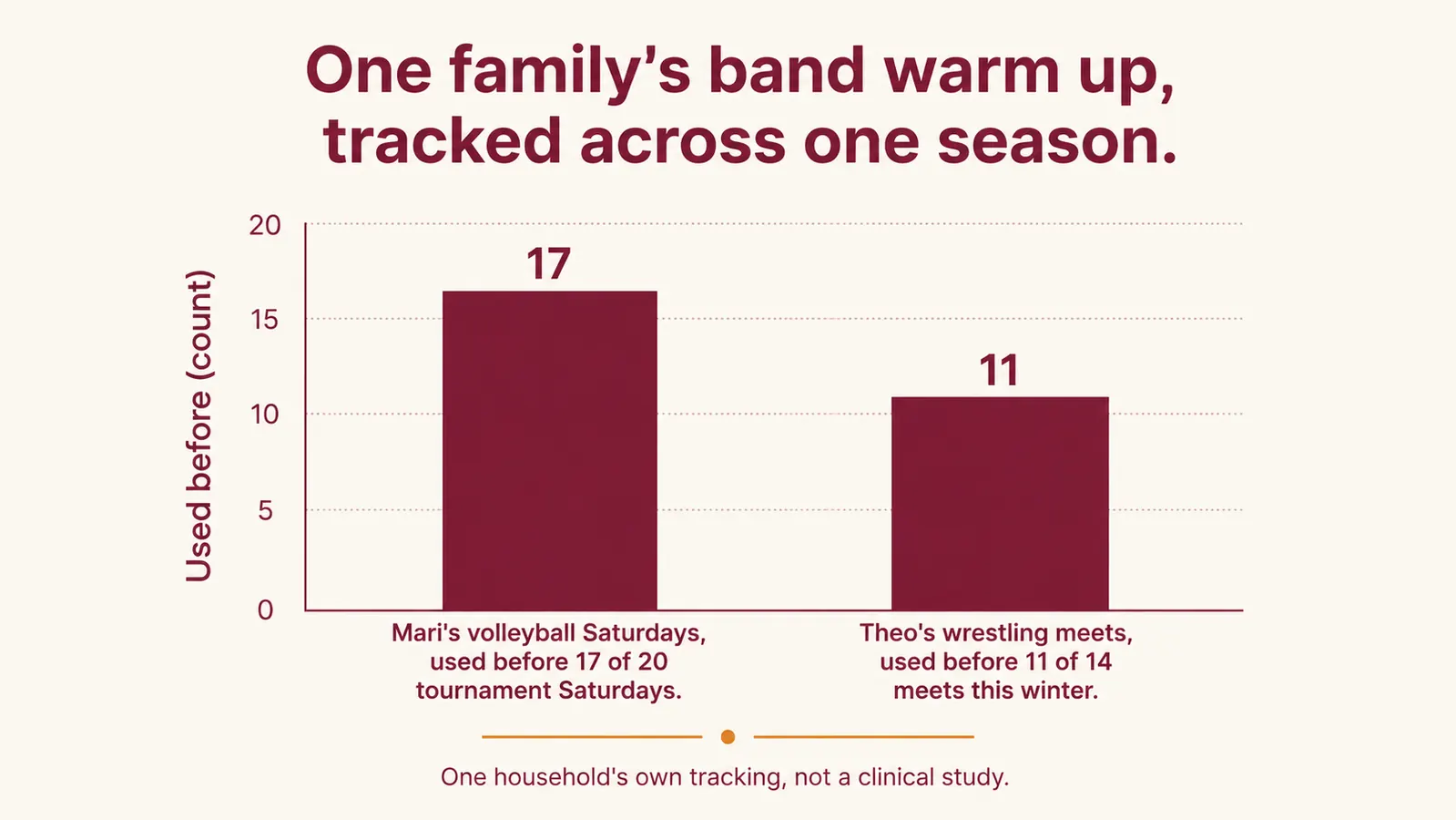
I will say that some Saturdays this whole sequence gets rushed or skipped entirely, usually the mornings we are running late out of the Pilot with the hatch still half loaded, and I can generally tell which kind of morning it was by how the first few minutes of the match go. That is not a scientific observation, just eleven years of watching from the same bleachers.
What Else Helps
The band is not the only thing that goes into a real warm up. Mari's trainer still has the team do a short jog and some dynamic stretching before any of this, and Theo's coach adds light partner drilling once the band work is done. The band handles the part that is hardest to get a teenager to do on their own in a few unsupervised minutes, waking up a shoulder or a hip that has been sitting still, but it is one piece of a longer routine, not the whole thing.
If you are trying to decide between a band like this and a plain stretch strap, I laid out how they actually compare for this kind of pregame use in a separate article, band with handles versus a stretch strap. And if you want the fuller picture of where the VEICK band has fallen short for us too, not just where it has helped, that is in the honest six month check in on the same band. Between the two, I think most families land in the same place we did, using the band for the shoulder and hip work above and keeping a strap around for the days someone wants a longer, slower stretch instead.
Five minutes with the band in a gym corner, and both kids look like themselves by the first point instead of the third.
A Cold Shoulder at the First Serve Is a Bad Way to Start a Match
The VEICK band with handles is what Mari and Theo actually reach for before matches now, since it takes a few minutes and no coach standing over them. Check today's price and current availability on Amazon.
Amazon Check Today's Price on Amazon →